


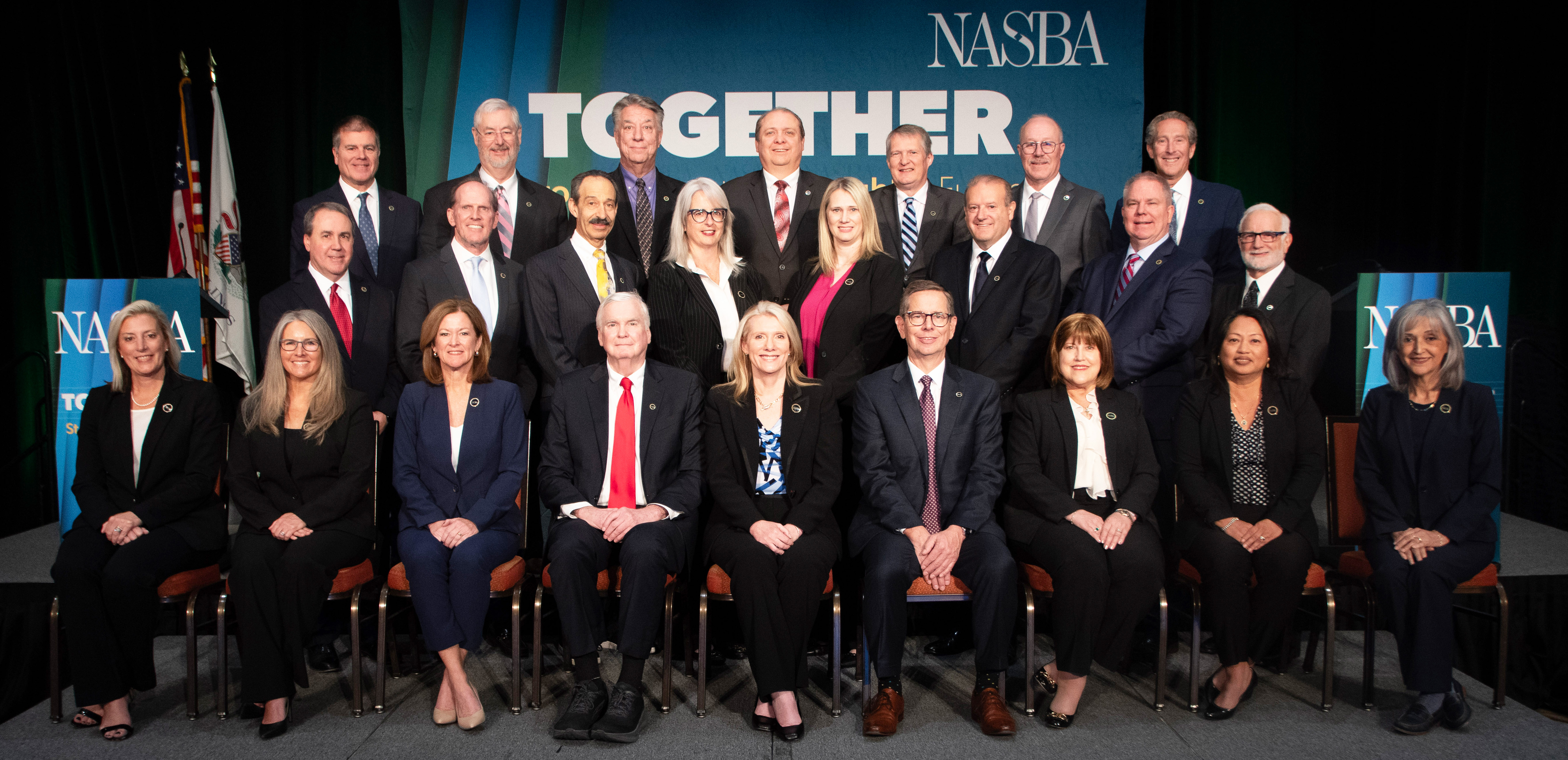
Regarded as a cornerstone of support within the organization, NASBA appoints as many as 30 committees and task forces annually. Through the work of these committees, NASBA volunteers and staff address current and emerging issues affecting state boards of accountancy. Topics range from ethics, education, and global regulation in accounting principles to the development of model rules for the member boards’ consideration.
Below is a listing of NASBA’s current Committees accompanied with each Committee’s Charge. To view the committee members and staff liaison(s), click the Committee name.
Administration and Finance Committee
Oversee and monitor the fiscal operations and investments of the Association.
Audit Committee
Oversee the Association’s annual financial statement audit and the internal controls, and shall recommend to the Board of Directors the firm to perform the audit.
Awards Committee
Recommend to the Board of Directors recipients of the Distinguished Service Award, William H. Van Rensselaer Public Service Award, and Lorraine P. Sachs Standard of Excellence Award.
Bylaws Committee
Review and consider best practices from various sources and recommend amendments to the Board of Directors for approval and subsequent vote by Member Boards.
Communications Committee
Promote effective and efficient communication among Boards of Accountancy, NASBA, and their respective stakeholders.
CPA Examination Review Board (ERB)
Evaluate and report on significant adherence with the policies and procedures utilized in the preparation, grading and administration of the Uniform CPA Examination and the International Qualifications Examination used by boards of accountancy for the licensing of certified public accountants; to include observation, inquiry and inspection of pertinent records; and report annually on the ongoing reliability of such examinations for the licensing of certified public accountants.
Continuing Professional Education (CPE) Committee
Develop and promote uniform rules and requirements for continuing professional education among the jurisdictions. Also, oversee the Standards for CPE Programs and the related CPE Standards Working Group.
Education Committee
Support the Boards of Accountancy by representing NASBA in the academic community and serving as an advisory resource on education matters related to the accounting profession.
Enforcement Resources Committee
Promote effective, efficient, and, where appropriate, uniform enforcement of professional standards by Boards of Accountancy.
Ethics Committee
Promote the development and maintenance of high-quality standards of ethical practice to protect the public interest. Provide input related to changes or developments in ethics-related standards.
Examination Administration Committee
Promote effective and efficient administration and operation of the Uniform CPA Examination.
Executive Directors Committee
Support Executive Directors in their roles with Boards of Accountancy.
External Relationship Assessment (ERA) Task Force
To conduct a comprehensive discovery and analysis of NASBA’s relationships with partnering organizations to ensure they strengthen NASBA’s mission, align with NASBA’s strategic goals, and enhance and extend the work of NASBA’s members.
Inclusion Committee
Provide opportunities, encouragement and support to underrepresented NASBA members to participate in service and leadership roles.
International Qualifications Appraisal Board
As directed by the Executive Committee, survey and assess professional practice standards and qualifications in specified countries and recommend the feasibility of recognition of credentialed non-US professionals to the Board of Directors.
Legislative Support Committee
Develop legislative support strategies and tactics to assist the Director of Legislative and Governmental Affairs in supporting Boards of Accountancy on legislative matters.
Nominating Committee
Nominate officers and directors, in accordance with NASBA’s Bylaws.
Past Chair Advisory Council
Provide background and counsel on current issues framed with a historical perspective.
Peer Review Compliance Committee
Promote effective oversight of practice quality of CPAs and their firms.
Regulatory Response Committee
Provide timely proposed responses on professional practice developments by either developing responses or reviewing the suggested responses from other NASBA committees.
Relations With Member Boards Committee
Provide reciprocal communication between Boards of Accountancy and NASBA Board of Directors.
Standard-Setting and Professional Trends Advisory Committee
Monitor and objectively evaluate processes of standard setters, as well as disruptive trends in the profession, on behalf of Boards of Accountancy. Recommend process improvements, when warranted, and advise the Boards of potential disruptive trends impacting the regulation of the profession.
State Society Relations Committee
Provide State Societies a platform to inform Boards and NASBA about issues of importance to the regulation of the profession, and enhancing Board relations with State Societies.
Uniform Accountancy Act (UAA) Committee
Oversee the Uniform Accountancy Act and related Model Rules and recommend amendments to the Board of Directors.